DeepSeek2026-10-18 03:52:13DeepSeek updates V4.1 Flash and opens Search API at 5 yuan per 1,000 callsDeepSeek rolled out another model update on Oct. 17, moving DeepSeekV4.1 Flash to the new V4.1-Flash-1017 version across its web interface, app, and API. According to information cited by The Paper, the company says the new release posts stronger benchmark results than the previous version while also cutting task runtime and output length, lowering cost and improving speed for users. DeepSeek described the change as a "Pareto improvement" in performance versus cost across multiple Harness environments. On the same day, the DeepSeek Harness team said version 0.2.1 now supports the new model and that the model received targeted optimization for Harness during training, improving task performance while reducing runtime, output consumption, and token costs. First-time users of DeepSeek Harness can receive a 6-yuan credit without making a deposit, though the offer is limited and expires seven days after it is credited. DeepSeek also announced that it has opened its in-house Search API. The company said the AI-native general search engine indexes hundreds of billions of webpages globally, supports multilingual search, and filters SEO spam, GEO manipulation, and low-quality AIGC content. The newly added Search and Fetch interfaces are priced at 5 yuan per 1,000 calls, and access through server-side tool calls in DeepSeek Harness, Claude Code, or Codex will be free until Nov. 1.30
Vercel2026-10-16 09:13:40Vercel adds Daemons and Drives, giving AI agents persistent background work and file storageVercel used its Ship 2026 developer conference to roll out a set of product updates that broaden what developers can run on its platform. The headline launch is Daemons, a new way to deploy long-running background processes directly on Vercel. These processes can continuously pull jobs from a message queue or database, finish one task, then move to the next, with automatic restarts if a process crashes. The feature is now in public beta. The company also formally opened Drives, a persistent file storage layer for AI agents. Previously, files inside a temporary sandbox disappeared once that sandbox shut down. With Drives, agents can keep code, data, and work output in separate storage and reuse them when a new sandbox starts. Developers can also clone workspaces so multiple agents can begin from the same file set and work on different jobs in parallel without overwriting one another. Vercel also added MCP Events to Connect, allowing agents to subscribe to events from external systems. In examples provided by the company, a compatible MCP service can send a notification when a new GitHub issue appears or when a document receives a new comment, letting an application trigger an agent without constant polling. That feature is also in public beta and requires external services to support event subscriptions.60
Circle2026-10-15 16:05:40Circle Says Gateway Transfer Volume Has Surpassed $10 BillionCircle said its cross-chain bridging service, Circle Gateway, has passed $10 billion in total transfer volume, according to a post cited by Techub News. The update points to continued usage of the company’s infrastructure product for moving value across supported blockchain networks. Circle described Gateway as a service built for developers and businesses, offering a unified way to access USDC balances on each supported chain. No additional operating metrics or chain-by-chain breakdown were disclosed in the brief announcement. The figure was shared through Circle’s own social media update and later relayed by Techub News as a short market bulletin under the technology category.60
Google2026-10-14 19:10:05Google showcases five Gemini 4 Argon builds, from a 3D game to playable WebMIDI instrumentsGoogle used its official X account to show what Gemini 4 Argon can do with five internal build examples posted shortly after the company said the flagship model had become broadly available. The examples ranged from a Fourier-epicycle animation of a pelican riding a bicycle to a stylized playable 3D game built in Three.js, a photo-to-digital-oil-painting workflow generated in Python, a WebGL Mahjong game made in Antigravity, and a 3D musical instrument created with WebMIDI and Three.js. Google’s Gemini API documentation says the model, listed as gemini-4-argon, has a shared context window of 1,048,576 tokens across input and output and can take text, images, video, audio, and PDF files. Promotional pricing runs through Nov. 30 at $2 per million input tokens and $10 per million output tokens, before rising to $4 and $20 from Dec. 1. Google also said standard users need a Google AI Pro or Ultra subscription to access Argon in the Gemini app and AI Mode in Search, with no access on the free tier. The company also pointed to internal usage data, saying engineering teams using Argon in Antigravity saw agent-submitted code volume rise by more than 35% while code rollbacks fell by nearly one-third. On benchmark results cited from a Google DeepMind model card, Argon scored 68.9% on the Vals Index, ahead of OpenAI’s GPT-6 Astra at 63.1% and Anthropic’s Claude Opus 5.5 at 67.0%, and posted 77.9% on DeepSWE v1.1. It did not lead everywhere: on Terminal-bench 4.0, Argon scored 57.4%, behind Opus 5.5 at 66.4%.100
Rex2026-10-12 10:25:49Rex adds Activity Mode for beta users, putting agent status in one sidebarRex, the new terminal project from Ghostty creator Mitchell Hashimoto, has rolled out a new Activity Mode to public beta users. The feature groups running and idle programs alongside Coding Agents in a sidebar and shows task status information, making it easier to spot work that needs attention and jump straight into the related terminal session. Rex uses the previously proposed OSC 7501 protocol so programs can report whether they are actively working, waiting on user input, or already finished. At the same time, the terminal does not rely on protocol signals alone. It also applies other signals and rules to decide which statuses should be shown and when, with the goal of cutting down on noisy notifications. Hashimoto said the team had long disliked task-style notification panels because they often generated too many alerts, with some becoming harder to use than email. He added that developer almonk spent several weeks refining the details in an attempt to build something the team itself would want to use over the long term. According to Hashimoto, early feedback from test users has been positive, though the feature is still being adjusted.310
Pine AI2026-10-10 10:47:38Pine launches cloud computer for AI agents, tops benchmark checkpoint score but trails on full task completionPine AI has introduced Pine Computer, a cloud-based computer built for AI agents. The product combines cloud virtual machines, AI models and operating tools, allowing developers to send tasks through an API so an AI system can operate browsers, software and files remotely instead of using a user’s local machine. Pine says its main improvement is giving the model direct updates from the browser and operating system, rather than relying on repeated screenshots to detect what changed after each action. According to the company, internal tests showed the setup could run tasks at 2x to 5x the speed of traditional vision-based agents. On SaaS-Bench v1.1, Pine posted a checkpoint score of 78.3%, ahead of Claude Code at 74.3% and Codex at 71.1%. That metric measures how many intermediate checks are completed during a task, not whether the entire task is finished successfully. Notes shared on X said Pine’s full task completion rate was 27.4%, below Claude Code’s 31.1% and Codex’s 29.2%. Pine also reported lower model costs, averaging about $1.02 per task, versus $20.50 for Codex and $26.50 for Claude Code. Those figures exclude cloud server costs, and the compared systems used different models and execution budgets. Pine Computer is currently in invite-only testing.260
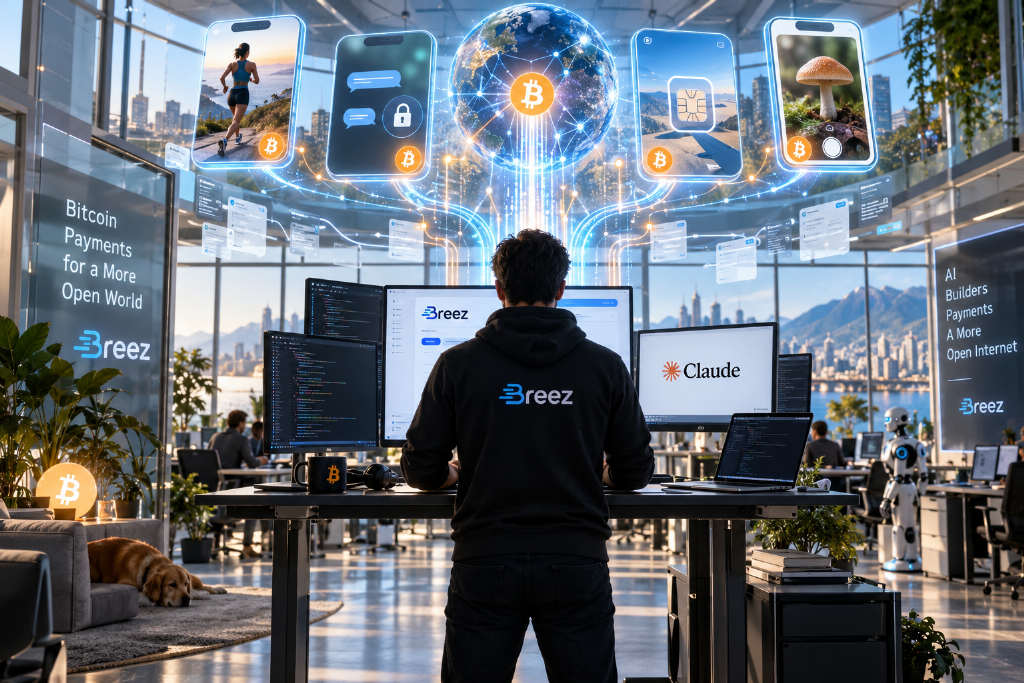
Bitcoin2026-10-08 19:17:12Breez Says AI Coding Agents Are Driving a Sharp Rise in Bitcoin Integration RequestsBreez, a bitcoin software company, said demand for its developer tools has jumped sharply as AI coding agents move into the mainstream, with partnership inquiries rising by roughly 14 times. In a company blog post, Breez linked the increase directly to Anthropic’s Claude Code, which launched as a research preview in February 2025 and became generally available three months later. The company said the profile of incoming developers has changed as well. Before 2025, most prospective partners were bitcoin enthusiasts, crypto-native developers, or fintech firms that viewed bitcoin mainly as an asset class. Since Claude Code arrived, Breez said it has been hearing from developers with little or no bitcoin background, including teams behind fitness apps, messaging apps, a traveler-focused eSIM service, and a mushroom-identification app. Breez also said a growing share of requests now comes from software agents acting on behalf of companies. The firm argued that bitcoin appeals to those agents because it is permissionless and can be integrated without opening bank accounts, completing onboarding checks, or signing forms. It added that its latest SDK implementation, built on the Bitcoin scaling protocol Spark, handled the added volume without issues.360
Claude Code2026-10-09 12:01:02Claude Code’s Mods turn an AI coding tool into a build-it-yourself playgroundAnthropic’s Claude Code has quickly become a canvas for developer-made mods after the company enabled its Mods system by default on Oct. 1. In just days, users built pixel pets, a Chrome dinosaur mini-game, a breathing guide that disappears when Claude finishes answering, and even Storytime, which runs a 260,000-parameter model inside Claude Code to narrate what Claude is doing in real time. The feature was first released by Claude Code lead Boris Cherny on GitHub in mid-September. The report argues that the bigger story is not the novelty of these experiments, but the architecture behind them. Anthropic said Claude Code’s own /diff change panel and AGENTS.md support were built with the same Mods mechanism and published in the repository with source code and tests. That puts Anthropic and outside developers on the same tooling layer. The launch also fits a broader product push. Anthropic introduced Claude Marketplace on Sept. 23, opened a plugin submission portal on Sept. 25, and then rolled out Mods on Oct. 1. Together, those moves gave the company a store, review pipeline, developer backend, and deep customization layer within 10 days. The article says the remaining question is whether developers will keep building for a closed platform that, based on public information, does not yet show a revenue-sharing model.330